
 Sarvam AI
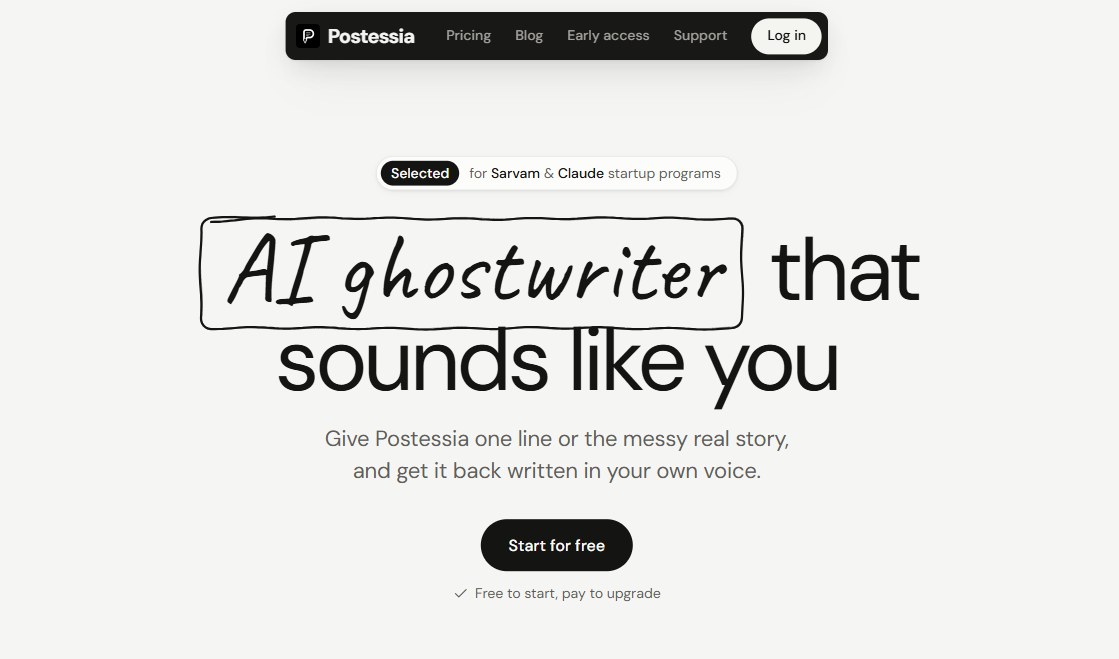
Postessia — Autonomous LinkedIn Content Engine in Authentic Voice
Postessia is an AI-powered LinkedIn content engine engineered specifically for creators, startup founders, and digital marketing agencies across India. Rather than producing generic, robotic AI outputs that degrade credibility, Postessia unifies real human voice calibration, situational storytelling, and streaming edge pipelines to generate high-converting thought-leadership content in sub-second latency.
The Core Problem: Why Generic AI Fails on LinkedIn
Most AI writing tools and generic wrapper SaaS platforms suffer from three systemic architectural bottlenecks when applied to professional personal branding:
- Repetitive Vocabulary & Syntactic Predictability: Standard ChatGPT outputs overuse formulaic tropes ("In today's fast-paced world...", "Delighted to share...", "A testament to teamwork..."), triggering immediate reader fatigue and algorithmic dwell-time penalties.
- Lack of Regional Nuance & Context Vectors: Global foundation models fail to grasp Indian startup terminology, Tier-2/3 consumer behaviors, Hinglish vernacular, and regional business idioms.
- High Latency & Blocking Completion Calls: Waiting 15 to 20 seconds for batch token generation breaks the creative flow of agency copywriters managing 10+ creator profiles simultaneously.
Postessia was architected from the ground up to solve these exact bottlenecks through custom prompt-chaining topologies and sub-second edge routing.
Architectural Strategy: Distributed Edge Streaming Topology
The platform architecture is designed around low-latency edge dispatch and deterministic token streaming:
1. Streaming Token Generation Pipeline
- Core LLM: Claude 3.5 Sonnet (
claude-3-5-sonnet-20241022) via Anthropic Messages Streaming API. - Edge Runtime: Cloudflare Workers deployed across 275+ global edge nodes so drafts start streaming quickly.
- Asynchronous Buffering: Upstash Redis queues handle burst loads and rate-limit smoothing during peak agency working hours.
2. Multi-Vector Tone Calibration Engine
- Analyzes a creator's historical top-performing posts using embedding cosine similarity.
- Calibrates across 6 orthogonal tone axes: Professional vs. Casual, Formal vs. Conversational, Insightful vs. Relatable, Humor vs. Serious, Narrative vs. Analytical, and Industry Terminology Ratio.
- Embeds Indian business context vectors (FinTech, EdTech, D2C, B2B SaaS) directly into system instructions without context window pollution.
3. Real-Story Situational Mode
- A structured prompt-framing engine that extracts raw bullet points, WhatsApp voice note transcripts, or meeting takeaways.
- Transforms raw thoughts into 8 proven agency blueprints: Executive Opinion, Startup Origin Story, "How-To" Skill Drop, Narrative Case Study, and Industry Trend Analysis.
Production Implementation: Edge Inference Worker
The following Cloudflare Worker implementation routes streaming completions directly to the client browser via Server-Sent Events (SSE), so text appears as it is generated:
// Edge Inference Worker Implementation (Cloudflare Workers / Next.js Edge)
import { Anthropic } from "@anthropic-ai/sdk";

export async function streamLinkedInPost(req: Request): Promise<Response> {
  const { prompt, toneProfile, blueprint, audienceRegion } = await req.json();

  const anthropic = new Anthropic({
    apiKey: process.env.ANTHROPIC_API_KEY,
  });

  // Synthesize dynamic system prompt with calibrated tone vectors
  const systemPrompt = buildSystemPromptVector({
    toneProfile,
    blueprint,
    audienceRegion,
  });

  const responseStream = await anthropic.messages.stream({
    model: "claude-3-5-sonnet-20241022",
    max_tokens: 1024,
    temperature: 0.72,
    system: systemPrompt,
    messages: [{ role: "user", content: prompt }],
  });

  return new Response(responseStream.toReadableStream(), {
    headers: {
      "Content-Type": "text/event-stream; charset=utf-8",
      "Cache-Control": "no-cache, no-transform",
      Connection: "keep-alive",
      "X-Accel-Buffering": "no",
    },
  });
}
Vector Normalization: Tone Calibration Algorithm
To prevent style drift over multi-turn generation sessions, Postessia runs an embedding cosine similarity check against the creator's top 10 historical high-engagement posts:
// Mathematical Tone Cosine Similarity Normalizer
export function computeToneSimilarity(
  generatedEmbedding: number[],
  authorBaselineVector: number[]
): number {
  let dotProduct = 0;
  let normA = 0;
  let normB = 0;

  for (let i = 0; i < generatedEmbedding.length; i++) {
    dotProduct += generatedEmbedding[i] * authorBaselineVector[i];
    normA += generatedEmbedding[i] * generatedEmbedding[i];
    normB += authorBaselineVector[i] * authorBaselineVector[i];
  }

  const similarity = dotProduct / (Math.sqrt(normA) * Math.sqrt(normB));
  return Math.max(0, Math.min(1, similarity));
}
8 Structured Agency Blueprint Topologies
Postessia provides 8 specialized content blueprints engineered to match LinkedIn's dwell-time algorithm:
- The Contrarian Take: Subverts mainstream industry assumptions with supporting data in the first two lines.
- The Behind-the-Scenes Build: Raw breakdown of architectural failures, pivoting decisions, and technical lessons.
- The Framework Breakdown: Multi-step tactical guides formatted for maximum screenshot and save rates.
- The Personal Origin Story: Founder journey narratives calibrated to eliminate performative vulnerability.
- The Customer Win Teardown: Metric-heavy client success studies highlighting specific business impact.
- The Tooling Stack Review: Technical analysis of developer tools, frameworks, and efficiency multipliers.
- The Market Shift Analysis: Forward-looking perspective on macroeconomic trends and industry inflection points.
- The High-Intent Direct CTA: Soft-sell conversion copy driving inbound profile visits and DM conversations.
Verified Production Outcomes & Impact
- 300+ Sign-ups: Creators and agencies who have signed up so far.
- 95 Lighthouse Score: Fast on phones, thanks to zero-runtime CSS, server-rendered HTML and components that load only when needed.